
CS Playbook · 8 pillars · 40+ templates
This is the how-to handbook: the processes, templates, and scripts for the eight pillars a growing customer service function has to get right. Written for teams under 150 customers, sequenced by install order, ready to deploy this week.
Instant download · PDF handbook + editable templates
Secure checkout · instant download.
The problem
Most improvement projects die in the same place. The audit was clear. The gaps were named. Someone even opened a spreadsheet. Six weeks later the everyday work reclaims the calendar and the improvement quietly becomes the one before it: a document nobody looks at.
The reason is almost never willpower. “Onboarding is broken” is a diagnosis, not a fix, and between the two sits a hundred small decisions every one of which you make faster with a pre-built shape to fill.
What the kickoff call sounds like. When a health signal deserves an outreach and when it doesn’t. Which template the CSM sends when the account has just gone quiet. The audit did not answer any of that, because it was not built to. This is.
Why eight pillars, and why in this order
Eight is the shape of the customer service operations function itself: five lifecycle pillars (onboarding, health scoring, renewals, expansion, escalations) and three infrastructure pillars underneath them (QBRs and EBRs, data and tooling, team structure). Not because eight is round. Because those are the eight places a growing function has to have a repeatable process, and skipping any of them means the customer feels the seam.
Order matters more than the list. Data and tooling comes first: until you can see what customers are doing, every other pillar runs half-blind. Onboarding next, because every downstream pillar reads the signals it produces. Health scoring after that. Escalations before renewals because handling one badly poisons the other. The full sequence is inside, and following it beats speed almost every time.
What you get
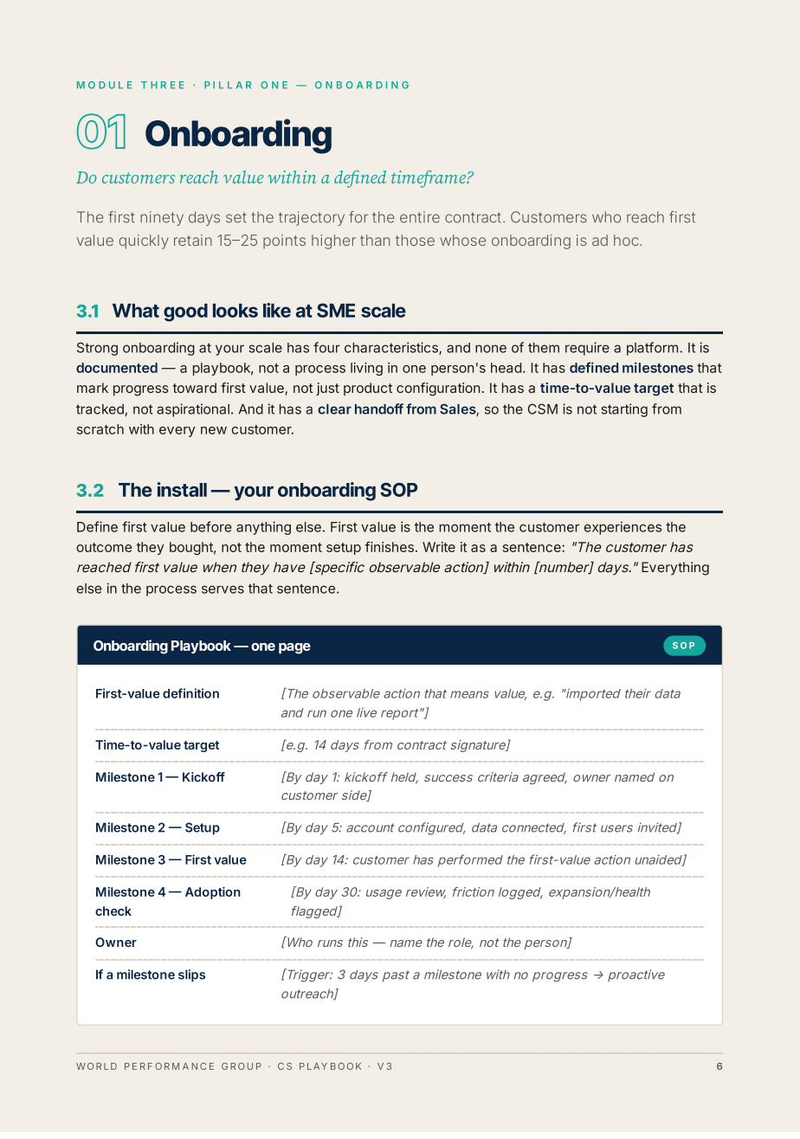
One chapter per pillar. Each gives you the process to install, the templates to install it with, and the words to use when the process touches a customer. Read in one sitting, then return to when you’re building.
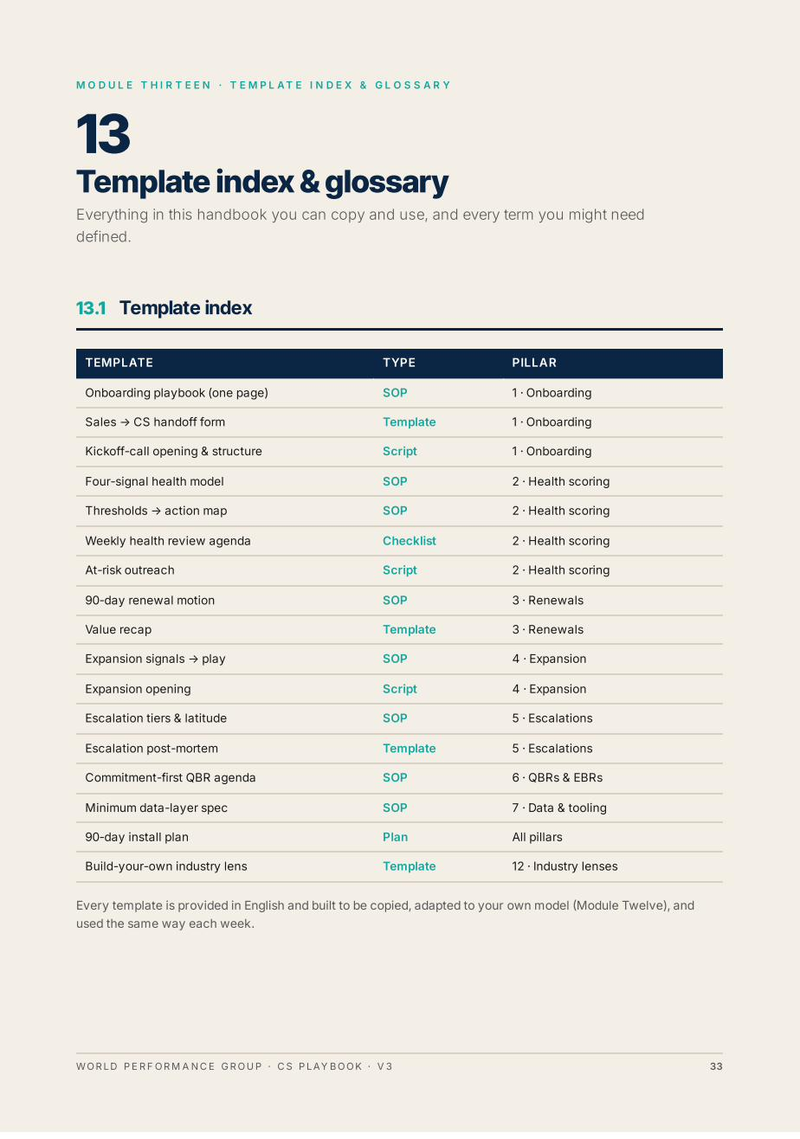
SOPs, scripts, checklists, and forms, every one indexed so you can find what you need in ten seconds. Editable, not locked. Copy them, adapt them to your operation, ship them.
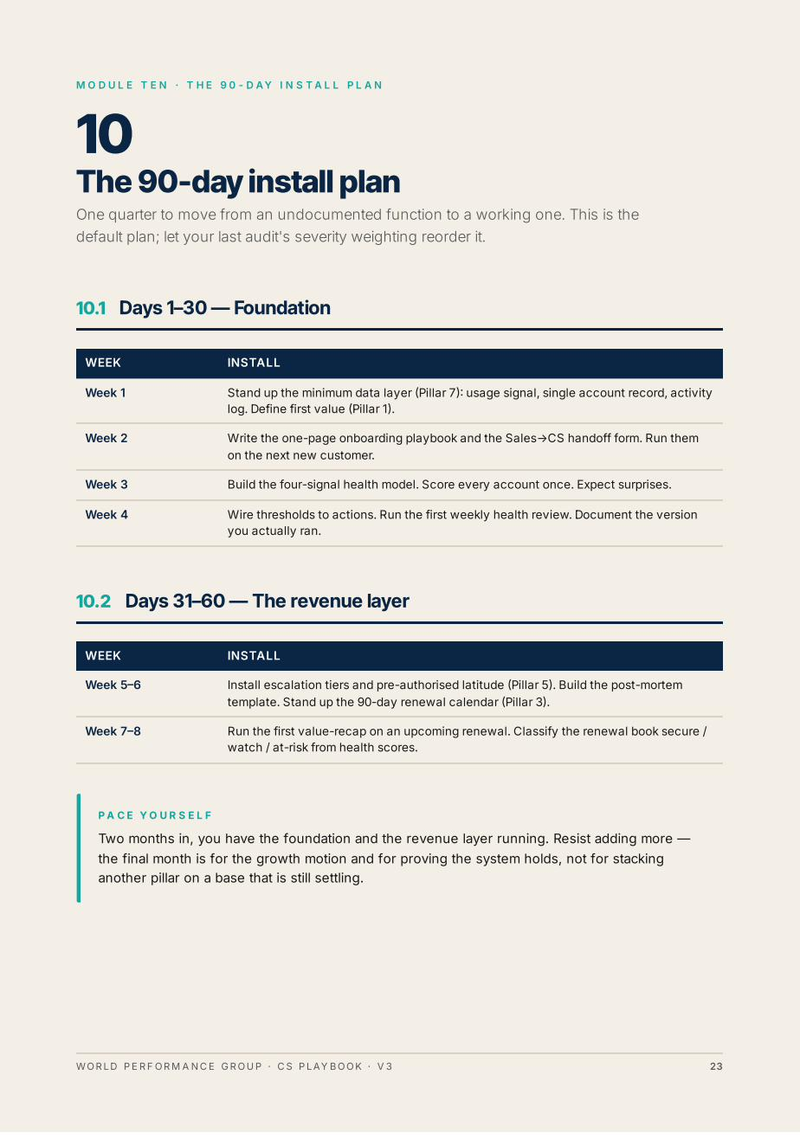
One quarter, one pillar at a time, in the sequence the pillars actually depend on each other. Not a suggestion: a plan you can hand to a project manager on Monday.
See it properly
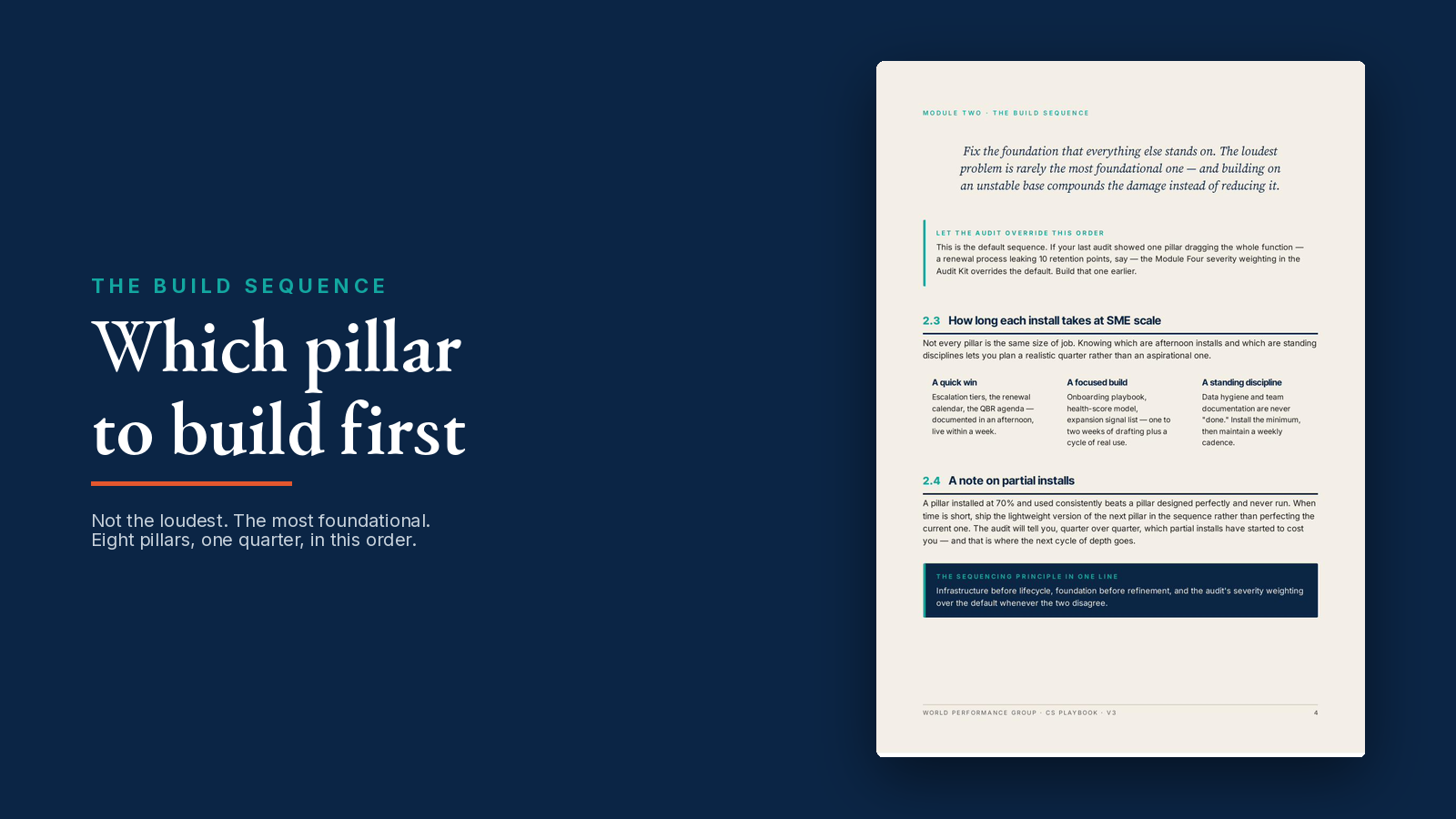
Not a mock-up. The build order the Playbook installs its pillars in: data and tooling first, team structure last, and six deliberate steps in between. If you install in loud-problem order instead, you build eight weak versions and burn the quarter proving it.
Why these eight
We run multilingual customer service operations for clients around the world. The eight pillars are not a longer list than the four in the Audit Kit. They are the same function seen from the perspective of “build” rather than “diagnose”.
Each pillar earned its place on three tests: it produces or destroys a specific customer outcome; somebody on your team can own it end-to-end; and it fails quietly enough that most functions do not notice it slipping until a customer has already left.
What you are buying is not templates. It’s the sequence: which pillar to build first, what “done” looks like, and the small mistakes we already made for you so you can skip them.
The chapters read the same way for a fifteen-person B2B function and a fifty-person consumer one, because the pillars are the same, and the industry lens is a filter you apply on top, not a different book.
How it runs
A team that tries to install all eight pillars (every part of your customer service operations) in one quarter installs eight weak versions. The rhythm below is designed to ship one real change instead, then the next one.
Ninety minutes, cover to cover. You will not use every chapter this quarter, but you will know what is in it, and you will stop guessing which pillar to touch first.
Usually onboarding or escalations. If the Audit Kit is what sent you here, it named this pillar already. The sequence chapter tells you when the “loud” pillar and the “right next” pillar are different things.
Use the templates as they are. Customise the wording, not the shape. The point is to ship the pillar, not to write a better version of a template we already tested.
Do not double-install. A function that ships one real change per fortnight compounds faster than one that half-ships four.
Honesty about fit
We would rather lose the sale than have you open the files and find they were built for an operation you do not run.
The guarantee
Thirty days. No form, no argument, no “what went wrong?” survey. One email and the money goes back.
And you keep the files. We cannot claw a PDF off your hard drive and we are not going to pretend otherwise. We would rather you kept a good opinion of us.
We can afford to say that because the product is good, and because €149 is not the point. A function of your size loses more than that in a single bad renewal conversation.
Before you buy
The Playbook hands you the templates for each of the eight pillars, organised the way you build them. The Operating System reframes the same work as a four-stage customer lifecycle and adds the operating layer above it: segmentation, governance, SOPs, and a companion suite of quick reference cards, hiring tools, and a metrics dashboard. If you want to build pillar by pillar, this is right. If you want a function-level system, that is the level up.
The Audit Kit tells you where you stand. The Playbook tells you how to build. Different jobs, in sequence: most buyers run the Audit Kit first and then use the Playbook to install the fixes it named. Buying both together makes sense; buying the Playbook alone works when you already know your gaps.
Yes. Every template is an editable document: no locked PDFs, no watermarked pages. Copy the file, change the wording, ship it. English throughout.
PDF for the handbook, editable documents for the templates. Opens in whatever tooling your team already uses.
Yes. One payment, the files are yours, no per-seat pricing. Most teams have one owner who runs the install and several people who read the chapters.
No. One payment, no renewal. You get updates when we ship them, but nothing turns off if you stop paying, because you are not paying anything.
Yes. One of the eight pillars is quality. You get the SOPs for a QA scoring rubric, the templates for quality reviews, and the process for turning QA findings into coaching. It’s built for teams doing manual QA, not for buying QA software. If you would rather have every chat conversation scored for you, our AI customer service platform does that automatically (launching soon).
The Playbook will still help, but past 150 you are into a different kind of operating discipline: segmentation, governance, tiered motions. That is what the CS Operating System and the Operating Reviews are built for.
One decision
Eight pillars, forty templates, one quarter. Enough to stop admiring the problem and ship the fix.
Get the Playbook for €149One-time · Instant download · PDF + editable templates · 30-day money back