What you get
The methodology, and the eight companions that install it
The methodology tells you what to do. The companions give you the artefacts to do it with – the difference between a guide you read and a system you run.
CS Operating System · The full system for running a CS function that’s ready to scale.
This is the full methodology a customer service function runs on – the four-pillar lifecycle, segmentation and health scoring, the renewal and expansion engines, and the governance that keeps it honest. Ships with eight companion documents that turn the methodology into daily practice.
Instant download · Methodology guide + 8 companion documents
Secure checkout · instant download of all files.
The problem
A function whose quality lives in one person is one resignation away from collapse. The goal is consistent delivery from defined process, not heroic delivery from talented individuals.
You cannot template your way out of that. Templates give you the pieces. What you need is the system beneath them – the constraints those pieces respect, the lifecycle they run on, and the governance that keeps them honest even when the person who built the whole thing walks out the door.What’s actually inside
What you get
The methodology tells you what to do. The companions give you the artefacts to do it with – the difference between a guide you read and a system you run.
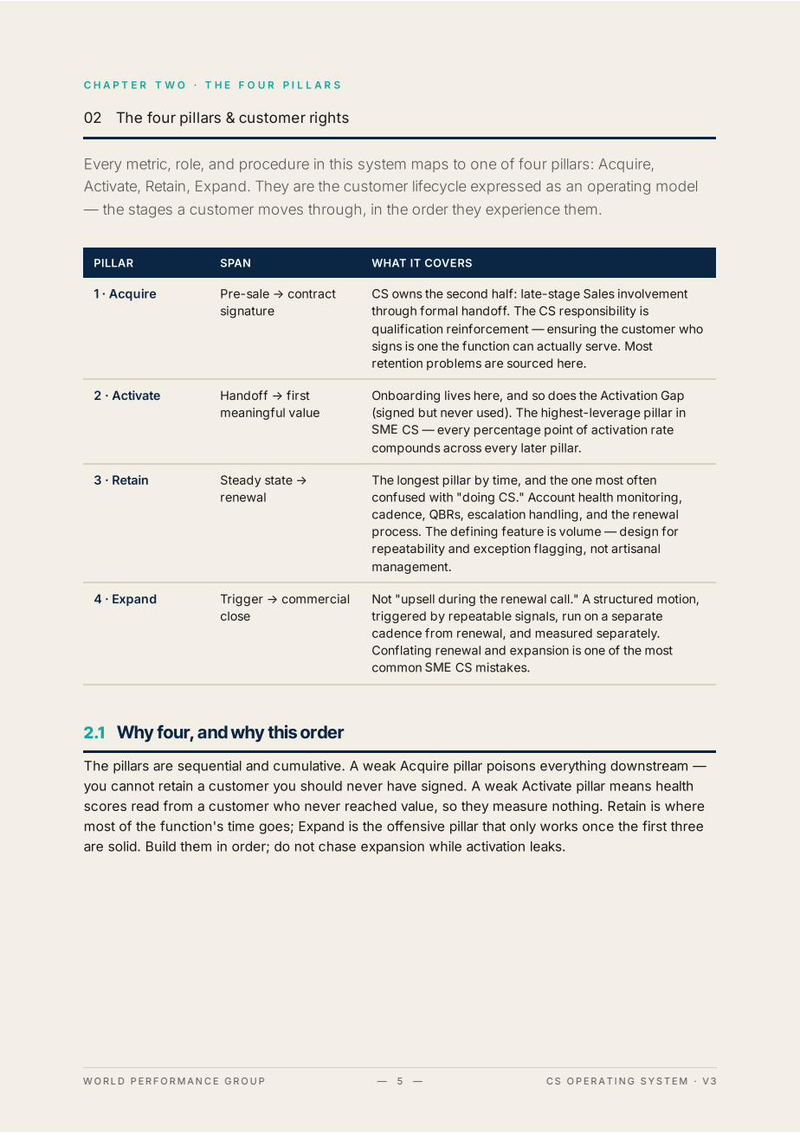
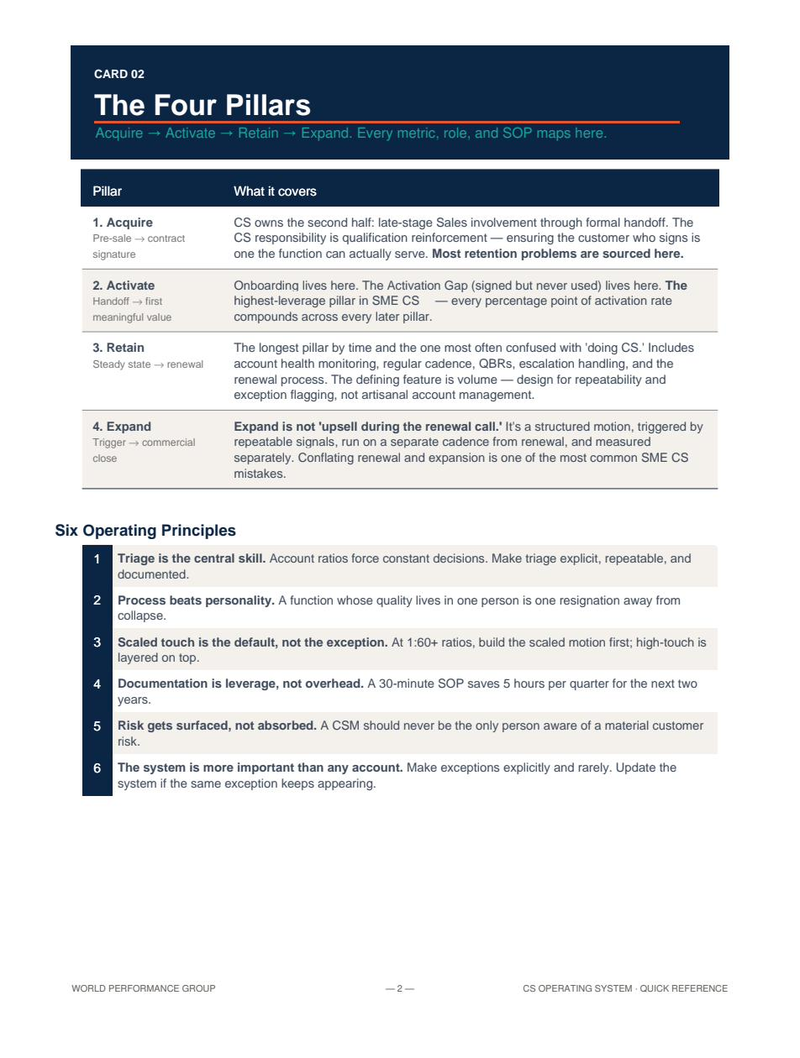
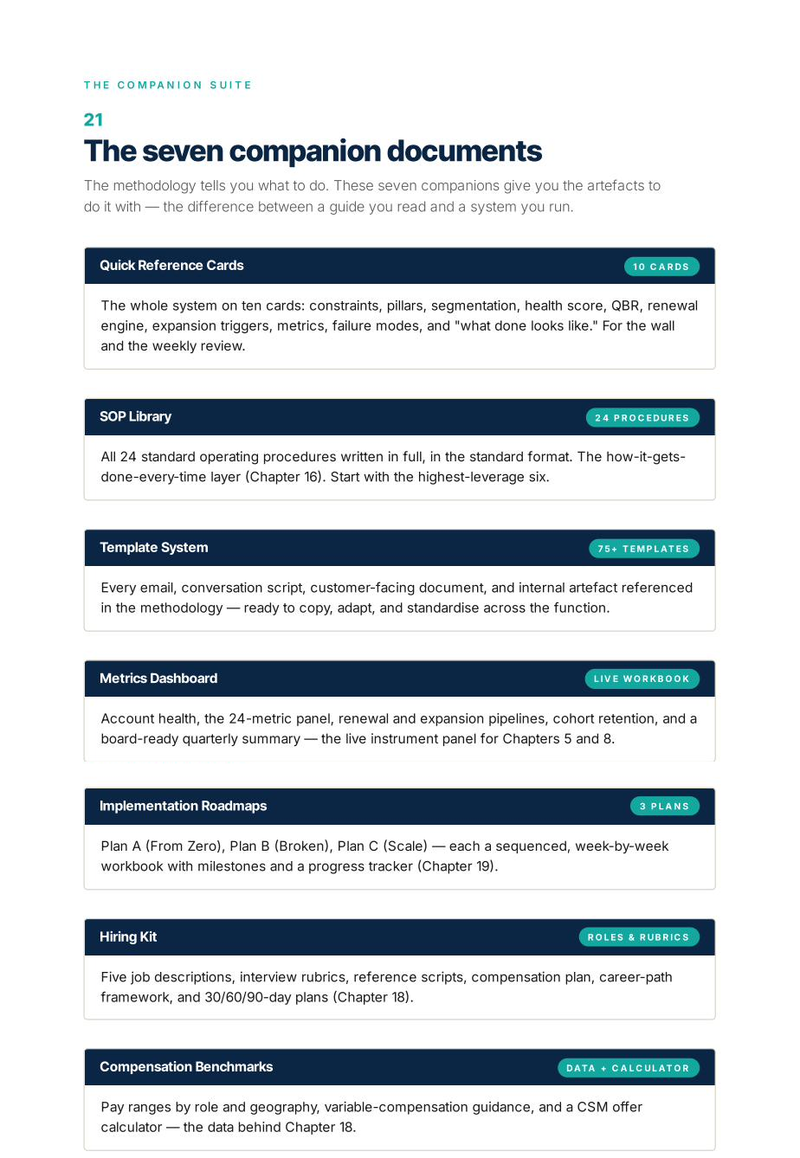
The measurement layer
This is the layer most SME CS functions never build. And it is the layer boards ask to see first.
Most SME CS functions track a few metrics in a shared sheet. This is what the layer looks like when it’s built as a system – one leader can run it, one board can read it, and it doesn’t fall over when the person who set it up moves on.See it properly
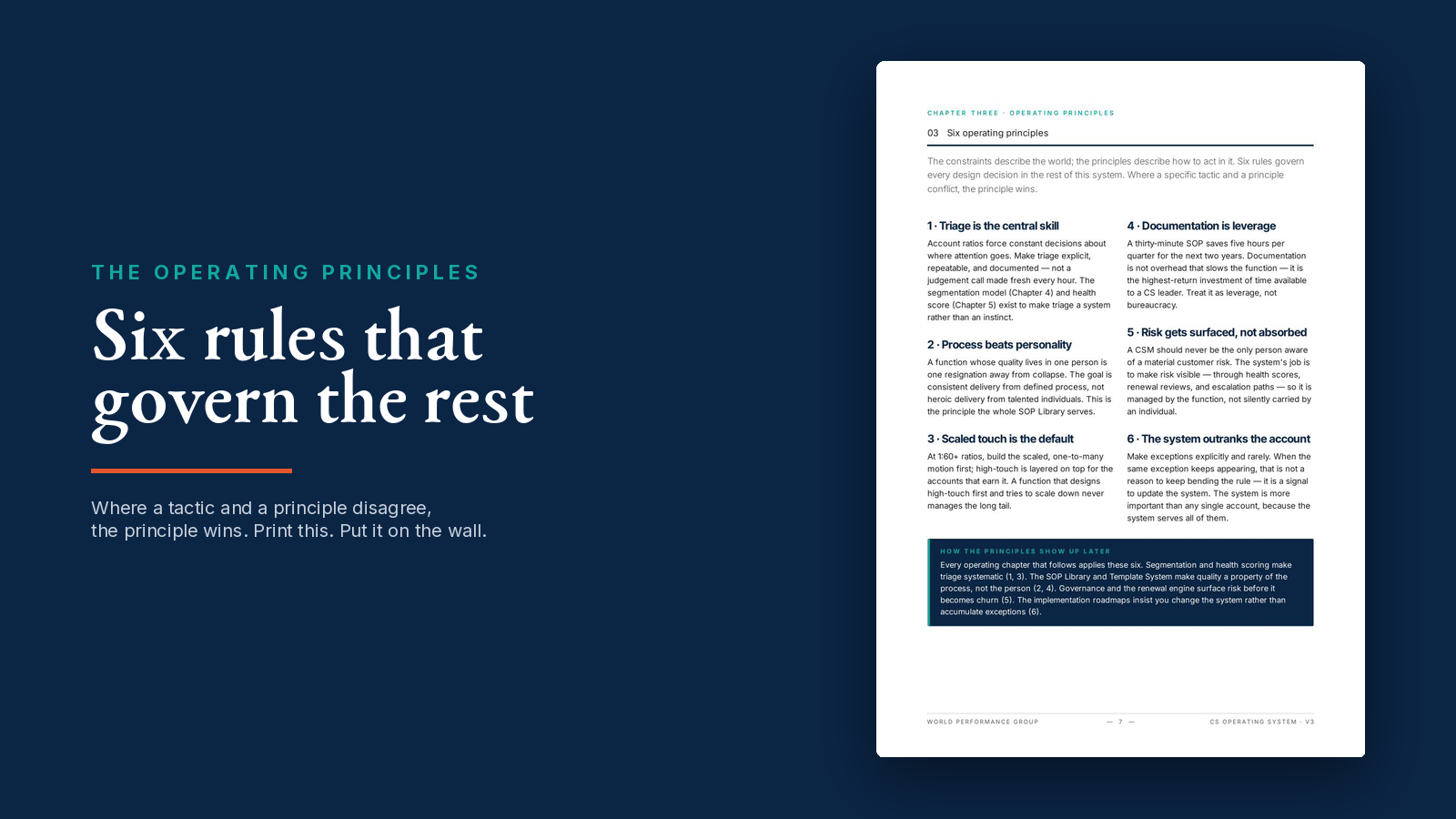
Not a mock-up. The six rules that govern every decision in the rest of the system – the ones that override any tactic, template, or exception the operating reality throws at you. Print this and put it on the wall.
Why this shape
The system is more important than any single account, because the system serves all of them. That is the sentence that decides how every exception, every escalation, and every one-off request gets handled.
Adopt the six, and everything else – segmentation, health scoring, SOPs, governance rhythms – follows from a place that will hold up when the person who wrote them leaves.How it runs
Honesty about fit
We would rather lose the sale than have you open the files and find the system was built for a function you do not run.
The guarantee
Thirty days. No form, no argument, no “what went wrong?” survey. One email and the money goes back.
And you keep the files – the methodology guide and every one of the eight companions. We cannot claw a PDF off your hard drive and we are not going to pretend otherwise. We would rather you kept a good opinion of us.
We can afford to say that because the product is good, and because €249 is not the point. A function of your size loses more than that when one senior person walks out with the institutional knowledge in their head.
Before you buy
The Playbook is organised around eight buildable pillars – how to build each one, with templates and scripts. The Operating System reframes the same work as a four-stage customer lifecycle and adds the operating layer above it: segmentation, health scoring, governance, and team design. If you want to build pillar by pillar, the Playbook is right. If you want the function to run as a system rather than as a set of practices, this is the level up.
The Audit Kit tells you where the function stands today. The Operating System tells you what a function should look like when it’s running well, and gives you the artefacts to install that. Diagnostic first, system second – most buyers do them in that order.
Quick Reference Cards (ten cards, one per key concept), SOP Library (twenty-four documented procedures), Template System (seventy-five-plus editable templates), the Metrics Workbook (nine working tabs), the Metrics Workbook Companion Guide (twenty-six pages walking through every tab, every KPI, and every operating rhythm), Hiring Kit (job descriptions, interview rubrics, reference scripts, comp templates), Compensation Benchmarks, and Implementation Roadmaps.
Yes. Every SOP is an editable document, every template is copy-and-adapt. English throughout. Print, share, standardise across your function.
PDF for the methodology, the Metrics Workbook Companion Guide, and the Quick Reference Cards. Editable documents for the SOPs, templates, and hiring materials. Excel for the Metrics Workbook and Compensation Benchmarks. Opens in whatever tooling your team already uses.
Yes. One payment, the files are yours, no per-seat pricing. The licence covers internal use across your organisation – the whole team can read, print, and adapt everything you receive.
No. One payment, no renewal. You get updates when we ship them, but nothing turns off if you stop paying – because you are not paying anything.
Fair. The Operating System is the self-service version of what our team installs on client engagements. If installing this yourself sounds like the wrong use of your quarter, Support Solutions is where our team takes the function on – with the same methodology, running as a service.
The system will still help, but past 150 you are into a different kind of operating discipline – segmentation, governance, and enterprise tooling become non-optional. That is what the Operating Reviews are built for, or Support Solutions if you’d rather our team took the function on directly.
One decision
Six parts, eight companions, one system. Enough to stop being one resignation away from chaos.
Get the System — €249One-time · Instant download · Methodology + 8 companions · 30-day money back