
Field notes · Diagnostics
How to tell if your customer service is actually any good
Most founders can name one thing that is wrong with their customer service. Response times are slipping on weekends. Two agents are strong and two are struggling. Weekly ticket volume is up and the team is not. The one thing they can name is usually the one thing they can already see.
The expensive problem is almost always the one they cannot see. Which is why a considered customer service audit – not a checkbox exercise, an honest one – is worth running periodically, even when nothing looks obviously broken.
Customer service breaks in four places, and the four hide each other. If your response times look fine, you may still have a resolution problem that no one is measuring. If your CSAT is strong, you may still have a coverage problem that only shows up on an unusual Monday. If the team is coping today, that tells you almost nothing about whether the team is coping in a quarter.
This is what the customer service audit is for – not because something is obviously wrong, but because the interesting problems are the ones nothing has flagged. Twelve questions, arranged around four gaps, answered honestly.
Here is the shape of it.
The four gaps every service operation has
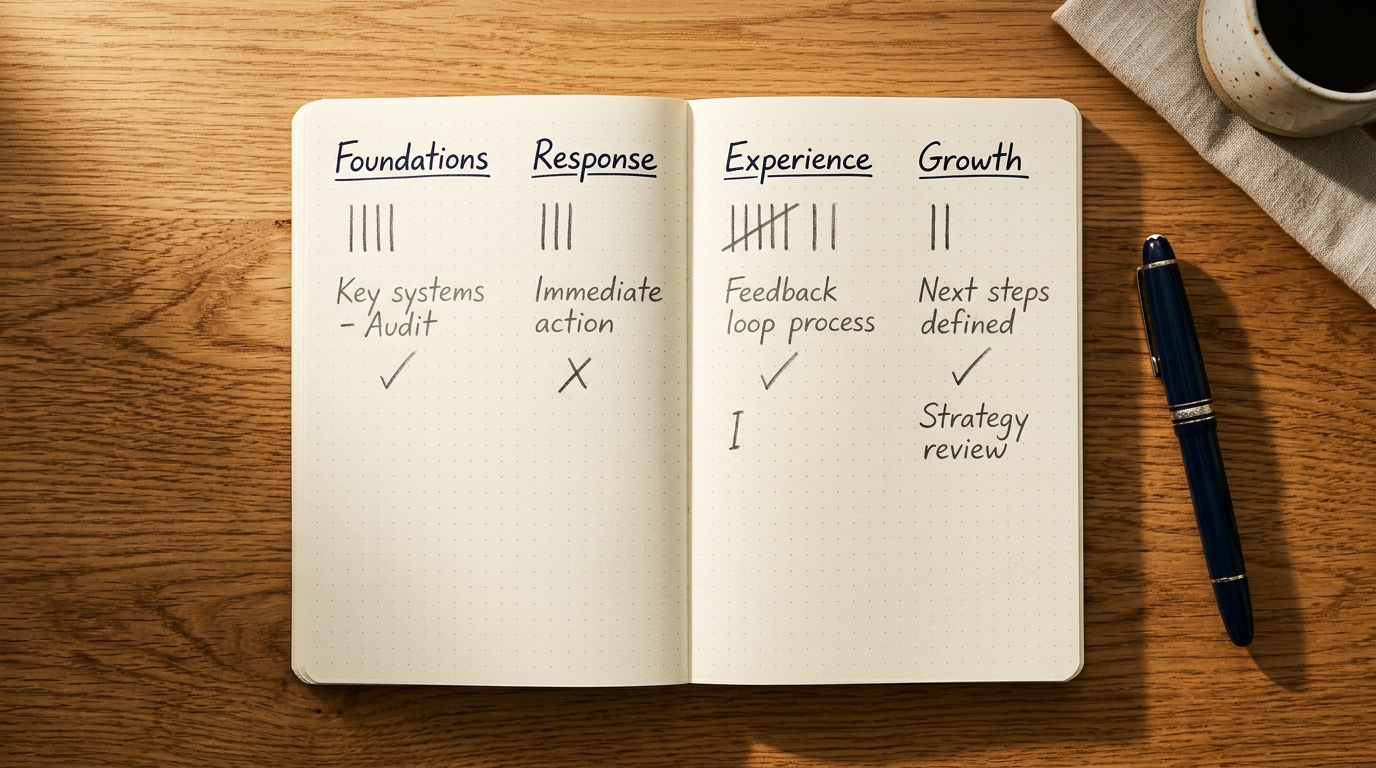
Foundations. Response. Experience. Growth.
Foundations are the measurement layer – whether you can see what is happening at all. Ticket volume, backlog age, resolution rates, coverage against forecast. If the foundations are missing, everything else is guesswork wearing the clothes of analysis.
Response is the speed layer – whether the reply happens in the window the customer will accept. The window depends on channel, sector and expectation. But the operation either meets it, consistently, or it does not.
Experience is the quality layer – whether the reply solved what the customer actually asked. This is not the same thing as whether the ticket closed. Tickets close for many reasons: the customer gave up; the reply looked helpful; the case was reassigned. Closure and resolution are not the same event.
Growth is the capacity layer – whether tomorrow’s operation will carry the volume you already expect. A team that copes at four hundred tickets a week is not necessarily a team that copes at six hundred.
Most customer service audits check response and stop there, because response is the easiest to measure. The other three gaps do the damage.
Foundations: whether you can see the operation at all
The first question is not “are we fast enough.” It is “can we tell.” Tooling that reports what happened yesterday, in a shape you can trust, is the base condition for every improvement that follows.
The typical foundations gap looks like this. The help desk exports data, but nobody has decided which numbers matter, so the weekly review is a list of everything with no signal. Or the numbers are reported but the definitions drift – first response time counted from ticket creation in one team and from first agent view in another, resolution counted at ticket close on email and at customer confirmation on chat. When definitions drift, week-on-week comparisons stop meaning anything.
Four foundational things should be visible, weekly, in one place: ticket volume by channel, first response time by channel, backlog age (not just backlog count), and a coverage number – planned hours against actual demand. The principle underneath all four is the one that sits at the heart of international quality standards for customer satisfaction, including ISO 10002: you cannot improve what you cannot see.
If any of those is missing or unreliable, foundations is your first fix. Not because it is the exciting fix, but because everything downstream is built on it.
Response: whether the reply lands in the window
Response is where most published metrics live and where most public complaints happen. First reply times, resolution times, SLA hit rates. These matter. They are also the numbers most likely to be reported optimistically, because response is a leadership number, and leadership numbers get gamed.
A more useful pair of questions than “what is our first response time”:
What is our first response time on tickets that arrive at 5 pm on a Friday? And what is it on tickets that arrive at 9 am on a Tuesday?
The average will hide the shape. The shape is where customers get hurt. If the Tuesday number is twenty minutes and the Friday number is forty-one hours, the average tells you nothing that helps a customer. It tells you the team is closed on weekends. Most customers already know that. The useful question is whether your service promise matches the shape you are actually running.
Response is also where channel choice matters. A customer who has just paid for something and has a question about it does not want an email. If the only fast channel is chat and the chat is closed after six, the response promise is a fiction after six.
Response is visible, so it gets fixed first. What gets missed does the damage.
Experience: whether the reply solved anything
Experience is the gap most operations underestimate.
The measurable version of experience is first-contact resolution – was the customer’s problem solved in the first exchange, or did they have to come back. Research on customer loyalty, including the well-known Harvard Business Review study on customer effort, consistently finds that resolving the problem on first contact – and reducing the work the customer has to do to get there – is a stronger predictor of retention than any surface delight. But FCR is easy to game, because it is easy to close a ticket and call it resolved while the customer, quietly, still has the problem.
The useful check is different. Take a random sample of tickets closed as resolved in the last month, and read them. Not the metadata – the actual thread. In perhaps twenty percent, you will find one of three failure patterns.
The reply answered the question the agent thought was being asked, not the question that was actually asked.
The customer said “thanks” without confirming the fix, and the ticket was closed on the “thanks.”
The customer sent a follow-up that received no reply, or a slow reply, and stopped writing in.
None of those will show as failures in the dashboard. All of them are failures.
The founder’s version of the customer service audit – for the experience gap – is short: sit next to your service lead for two hours, once a quarter, and read tickets you did not choose. Anything else is theatre.
Growth: whether the operation will carry the next six months
Growth is the fourth gap, and the one usually skipped in a customer service audit because it is the most speculative.
The question is simple. If ticket volume rises forty percent over the next six months – which for most SME operations is a plausible scenario – does the operation carry it, or does it break?
A team is carrying today’s volume when it has slack. Slack means shifts where the queue empties, hours where the team is not on tickets, backlog age that trends down not up. A team that ends every week with the queue where it started, and no visible slack, is running at capacity – and capacity is a fragile place to run from. The first unusual Monday puts you underwater.
Growth also has a hiring question. Not “when do we hire” – that is a lagging indicator. The question is: what does it take to onboard a new agent to competence, and how long does it take. If the answer is “we do not know, we have not hired in a while,” growth is a gap.
The uncomfortable observation
Most operations think their biggest gap is response. It is almost never response. Response is visible, so it gets fixed first. What gets missed is either foundations – no reliable measurement, so decisions are guesses – or experience – closed tickets that are not resolved tickets.
The four gaps hide each other. That is why an audit worth running looks at all four.
Twelve questions for a customer service audit
Three per gap. Foundations: can you see it, can you compare week to week, can you trust the numbers. Response: how does the shape look at the edges, does the channel promise match the coverage, how do exceptions get handled. Experience: what do the resolved-and-closed tickets read like, what do customers do after resolution, what happens on the second contact for the same issue. Growth: what does a forty-percent rise do to the queue, how long to competence for a new hire, what is the shape of the workload three months from now.
The reason to run these questions is not that anything is obviously wrong. It is that the interesting problems are almost always the ones nothing has flagged yet.
If you would rather start from a working customer service audit than build one from scratch, the 12-Point Health Check is the version we use – free, structured across the four gaps, and honest. It takes about an hour, and it usually surfaces at least one problem the operation had not named.
Run the free 12-Point Health Check
Twelve questions, four gaps, one honest picture of where your customer service actually stands. No consultant required, no sign-up wall, no ninety-day report. About an hour of your time.
Start the Health Check →